The Maple Grove Eye Doctors team, located inside Pearle Vision Maple Grove, offers comprehensive eye exams for patients of all ages. Whether you need an updated prescription, a contact lens evaluation, a routine checkup, or advanced diagnostic imaging, our optometrists can evaluate your eye health and test for early signs of disease in a single 40-45-minute appointment. We are open seven days a week and offer same-week appointments.
Maple Grove Eye Doctors is a full-service optometric clinic, and we tailor each appointment to your specific needs in a welcoming environment. Every Maple Grove eye exam is designed to give you a clear understanding of your eye health and the steps needed to maintain healthy vision.
What Is a Comprehensive Eye Exam?
A comprehensive eye exam is a detailed evaluation of your vision and eye health by an optometrist. Unlike a quick vision screening at school or work, a full eye exam:
- Measures how well you can see and how well your eyes move together
- Checks for changes in your prescription
- Evaluates the overall health of the anatomy of the eye
Eye exams are typically performed annually to help maintain optimal visual clarity and to detect eye conditions early. Since several eye diseases develop without obvious symptoms, your eye doctor can check for signs of:
- Allergies
- Dry eye disease
- Cataracts
- Macular degeneration
- Glaucoma
- Diabetic retinopathy
- Conditions like hypertension
- And other conditions affecting your comfort and long-term vision
Comprehensive Exam vs. Vision Screening
Vision screening is a quick check to determine only basic visual acuity (reading letters on the chart). Performed in schools, workplaces, and during pediatric appointments, vision screening is only a broad screening tool. It cannot assess overall eye health as a comprehensive eye exam can. A full eye health checkup may include prescription testing, evaluation of eye coordination, and a detailed assessment of the retina and optic nerve, as well as internal and external eye structures.
Exam Vision Tests
In the “eye exam near me” searches online, you will see how these services include multiple tests. There is visual acuity testing, depth perception testing, color vision evaluation, eye teaming assessment, and prescription determination. These tests help identify nearsightedness (myopia), farsightedness (hyperopia), astigmatism, and presbyopia, which can contribute to eye strain, blurry vision, headaches, or difficulty focusing.
Exam Eye and Whole-Body Health Screening
Comprehensive eye exams can also detect medical conditions that may affect more than just your eyes. The blood vessels and nerves inside your eyes can reveal early signs of high blood pressure, diabetes, dry eye disease, autoimmune conditions, and other systemic concerns. Your doctor may also diagnose and treat dry eyes and ocular allergies. It allows identifying changes before they worsen.
Benefits of Regular Eye Exams
 Most people visit an eye doctor when something seems wrong. A regular eye exam is an important part of preventive healthcare, even if your overall vision seems fine. Many eye conditions progress slowly and without obvious symptoms, making routine monitoring crucial for long-term vision health. Changes in a vision prescription can also go unnoticed.
Early Detection Means Better Outcomes
Conditions like diabetic retinopathy, glaucoma, cataracts, and macular degeneration are often easier to manage when detected early. Time sensitivity helps prevent progression, allows doctors to suggest less intensive treatments, and helps you lead a better quality of life. Treating diseases early is also less expensive. It positions you better to improve your long-term health.
Track Changes Year Over Year
Annual eye exams create a baseline for your vision and eye health. You can compare images, prescriptions, and measurements from your previous visits to identify subtle changes that might otherwise go unnoticed. Even small shifts in vision, eye pressure, and retinal changes are easier to monitor when there’s a visible point of comparison.
Stay Sharp at Every Age
For many adults, an outdated prescription may be common. An outdated prescription can be an unrecognized cause of digital eye strain, eye fatigue, headaches, and difficulty driving or reading. Yearly comprehensive eye testing ensures a current prescription.
Children also benefit from routine eye exams for improved learning, classroom performance, and sports participation. Visit our Kids’ Eye Exam page to learn more about pediatric eye care.
Healthy adults and children are advised to schedule a comprehensive eye exam once every year. The schedule for eye exams depends on age, medical history, and risk factors.
What to Expect During Your Eye Exam
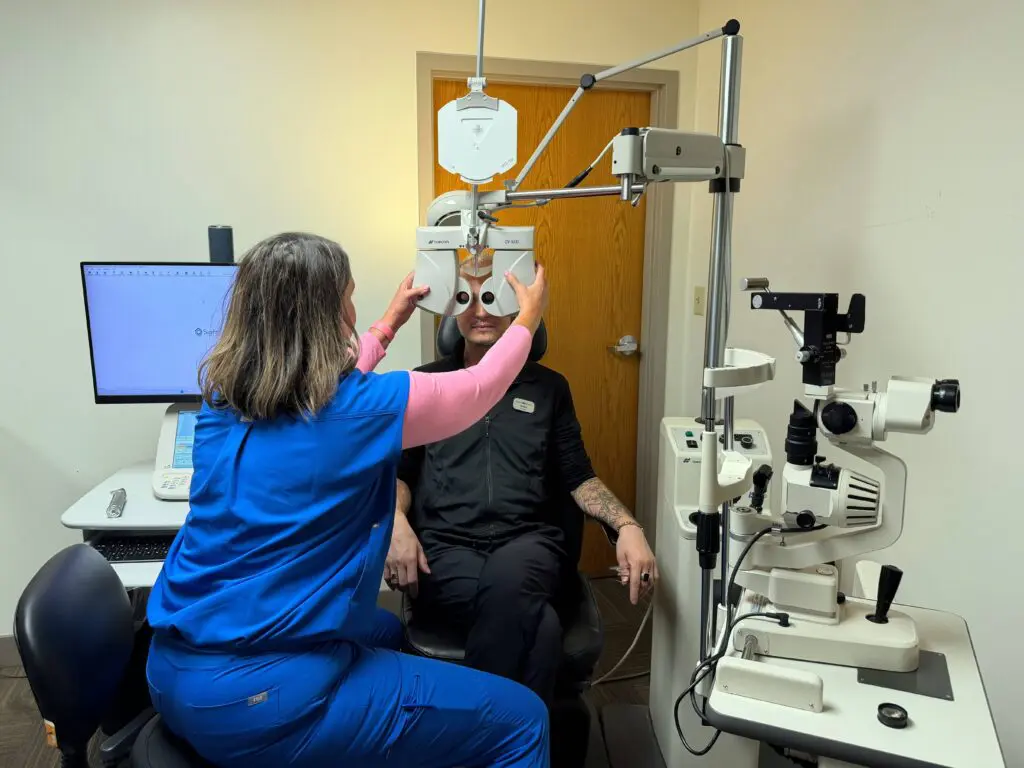 A comprehensive eye exam is a straightforward and comfortable experience, and typically lasts around 40-45 minutes. The visit can include vision pre-testing, an eye health evaluation, and time to discuss any concerns about vision with your doctor.
For First-Time Patients
If you are visiting our office for the first time, please arrive 10-15 minutes early to complete your health history form and intake paperwork. For annual visits, you may be asked to sign a HIPAA consent and patient responsibility form. Call 763-416-0622 or click here to book your visit.
What to Bring
On the day of your appointment, please bring the following:
- Your current glasses (everyday, reading, and/or computer)
- Current contact lenses or prescription
- Sunglasses to protect your eyes after dilation
- A valid photo ID
- Your insurance card
- Previous medical records (if this is your first visit with our doctor)
- Current medication list
Your Exam, Step by Step
During your eye exam, your eye doctor evaluates your vision and overall eye health. Depending on your needs, your doctor might assess the following:
- Personal and family health history
- Vision with current glasses or contact lenses
- Pupil reaction to detect abnormalities, such as a neurological condition
- Extraocular motility to ensure all ocular muscles are functioning well
- Peripheral vision
- Color vision and depth perception
- Examination of the retina and blood vessels
- Eye pressure and optic nerve testing for glaucoma screening
- Early indicators of problems like cataracts, glaucoma, macular degeneration, and diabetic eye diseases
- Testing for dry eye disease, allergic conjunctivitis, redness, irritation, eye fatigue, high blood pressure, and other conditions
Your eye doctor will explain the results, answer your questions, and discuss recommendations for glasses, contact lenses, treatment options, and follow-up care if indicated in the exam..
Dilation and What Happens After
If your doctor suggests it, you may benefit from pupil dilation during your eye exam. Dilation of the pupils helps the doctor examine the retina and optic nerve thoroughly for conditions that might otherwise go undetected. When dilation is performed, it takes 20-30 minutes to take effect. Dilated eyes remain sensitive to light for several hours afterward, and near vision may remain blurry for 3-4 hours. It is recommended to bring sunglasses and/or to arrange a ride after the exam. We also offer Optomap ultra-widefield retinal imaging as a no-dilation alternative (see the section below) for a more comfortable experience.
Advanced Imaging: Optomap & Topcon Maestro
Advanced retinal imaging is revolutionizing eye care. It provides eye doctors with a more detailed view of the eye’s internal structure and enables earlier detection of diseases. At Maple Grove Eye Doctors, we use cutting-edge technologies, including Optomap (or Optos) and Topcon Maestro, as part of our comprehensive eye exams.
Why Advanced Imaging Matters
Advanced imaging in comprehensive eye exams allows the eye doctor to detect subtle changes before symptoms become noticeable by providing a broader view of the back of the eye than dilation. These scans can reveal early diabetic retinopathy, small retinal tears, optic nerve changes associated with glaucoma, and signs of macular degeneration. The images also provide a baseline for future comparisons during annual eye exams.
Optomap Ultra-Widefield Retinal Imaging
The inclusion of Optomap or ultra-wide 2D imaging in our comprehensive eye exams helps capture a 200° view (about 82%) of the retina in a single scan. This provides a higher-resolution view of the back of the eye, unlike methods that only offer a 45° view. Optos can also eliminate the need for pupil dilation, making the process faster and more comfortable. It helps evaluate the retina for tears, holes, diseases, and other abnormalities that may be difficult to detect otherwise.
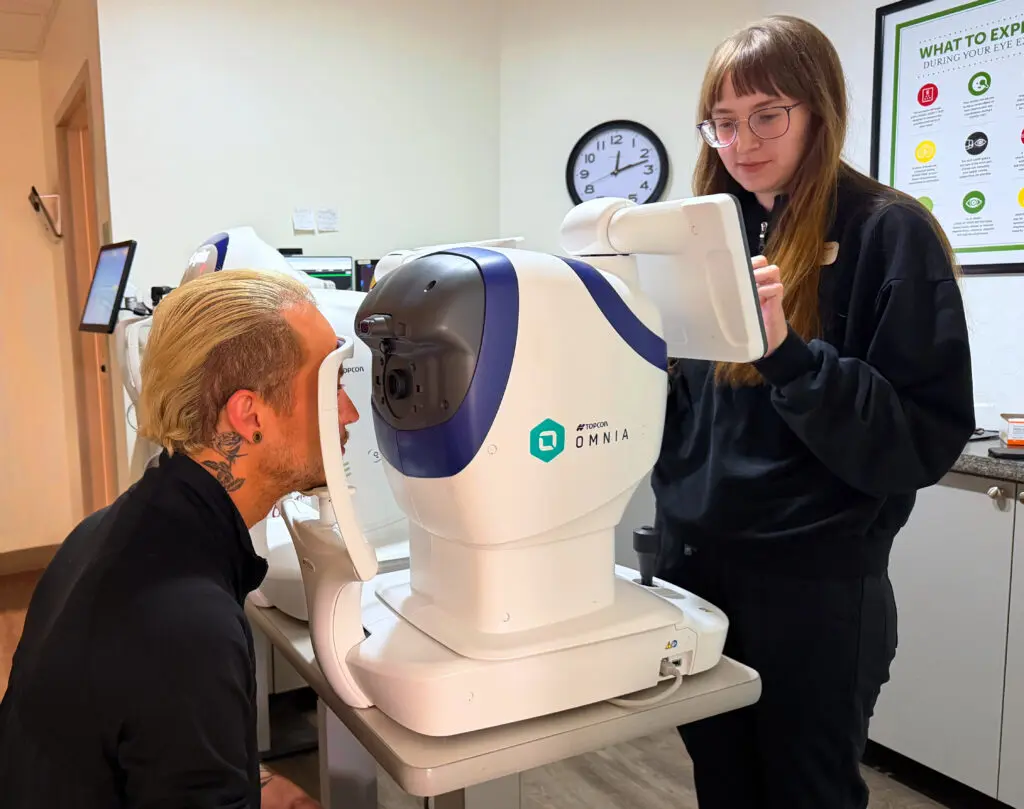
Topcon Maestro OCT Imaging
While Optos offers a peripheral view of the retina, it is not as detailed as the Topcon Maestro OCT system. This automated, noninvasive, trans-pupillary imaging technology combines high-resolution Optical Coherence Tomography (OCT) with a true-color fundus camera to provide a 3D view of the retina, optic nerve, and anterior segment.
The OCT test is fast, comfortable, and non-contact, producing a layer-by-layer cross-sectional image. It is especially useful for monitoring glaucoma, macular degeneration, and other retinal conditions. This amazing technology provides our patients with a higher level of care and enables our optometrists to achieve greater diagnostic capabilities. For the Topcon Maestro + Optos eye exam testing there is a small fee of $39.
Eye Exam Pricing
We believe pricing should be simple and transparent. If you have questions about the cost of your exam, contact us to review everything before your appointment.
When you self-pay and self-submit to insurance, you must pay at the time for your eye exam and then request reimbursement from the insurer. We will provide the itemized receipt for submission to insurance.
Insurance
At Maple Grove Eye Doctors, we accept major vision and medical insurance plans, including Eyemed Vision Care®, Aetna, Humana, Hennepin Health, and VSP. Medical insurance can be billed for various medical conditions of the eye. Your coverage may vary by provider, employer, plan type, and location. Remember to bring your insurance card to your appointment and confirm all benefits in advance.
We also accept out-of-network patients. Simply use the self-pay/self-submit option for reimbursement eligibility. Visit our Insurance page for a full list of accepted plans and additional billing information.



Frequently Asked Questions
A: Most adults and children with good vision and no major risk factors need a comprehensive eye exam every 1-2 years. Healthy adults aged 18-40 can schedule an eye exam every 2-3 years. Patients with hypertension, diabetes, eye conditions like glaucoma, and those above 65 might require frequent checkups over the course of a year.
A: Dilation is not required; however it provides a more detailed view of the retina and the optic nerve. You may need dilation every time if you are over 60 years of age, or if you are experiencing sudden vision changes. If you prefer to avoid dilation, Optos (available as a $39 add-on) provides a compatible view of the retina.
A: During a comprehensive eye exam, the optometrist evaluates your medical history, vision sharpness, prescription, eye alignment, eye pressure, retinal health, blind spots, and conditions such as cataracts, glaucoma, and macular degeneration.
A: Self-Pay: Our in-store eye exam is only $89 (tax not included). Contact lens evaluations start at an additional $59. If you are a new self-pay patient at our office, we offer a one-time NEW PATIENT eye exam price of $69 (additional cost for contact lens evaluation), with the purchase of a complete pair of RX sunglasses or eyeglasses or purchase of a year supply of contact lenses. How cool is that?
If you are a ‘Self-Pay/Self-Submit’ to insurance: You will be required to pay the insured cost of an eye exam and then submit the receipt to your insurer, for reimbursement. Not too complicated, right?
A: Bring your current glasses or contact lenses, medication list (if any), insurance card, sunglasses, and an ID card handy. Take note of your symptoms and questions to ensure all questions are answered in the appointment . If your eyes are dilated, you should consider arranging a ride back to the office or home.
A: Our comprehensive eye exams take around 40-45 minutes. Visits involving dilation, contact lens fitting, advanced imaging, and other specialized testing, especially for children and older adults, can take longer. New patients should expect to spend more time to complete the initial intake process.
A: We want to make it as easy as possible. If we could do it by mental telepathy, we would! But, until we can figure that out, you can book an eye exam by phone at 763-416-0622 or you can by clicking the button below. Eye exams are available seven days a week for your convenience.
Schedule Your Exam
Whether you need a routine eye exam, ongoing monitoring of an eye condition, or an advanced retinal scan, our eye doctors can provide complete care. Appointments are conveniently available seven days a week at our Maple Grove location inside the Pearle Vision location .
You can schedule your comprehensive eye exam today to protect your vision and the health of your eyes.
Call (763) 416-0622 or fill out this contact form for assistance.